
Central Asia's Infrastructure Moment
Central Asia is experiencing a sustained infrastructure build-out driven by three overlapping forces. The Belt and Road Initiative continues to channel investment into cross-border transport corridors across Kazakhstan, Uzbekistan, Kyrgyzstan, Turkmenistan, and Tajikistan. National government road modernization programs — Kazakhstan's Nur Zholy, Uzbekistan's public investment in regional highways, and Kyrgyz corridor improvements — are generating independent demand for road safety systems. And the region's solar energy potential — Kazakhstan and Uzbekistan have among the world's best solar irradiance levels — is driving utility-scale solar project development that requires durable mounting structures.
What makes Central Asia genuinely demanding for steel infrastructure is a combination of climate conditions that tests conventional materials: extreme continental temperature variation, winter cold, seasonal snowmelt, and varying levels of industrial and salt-based de-icing exposure. These conditions reveal the limitations of hot-dip galvanizing in ways that aren't always obvious from standard product literature.
Understanding Central Asia's Corrosion Environments
Kazakhstan: Continental extremes and de-icing exposure
Kazakhstan spans the world's largest landlocked territory and experiences temperature ranges from -40 degrees Celsius in winter to +40 degrees in summer — a 80-degree annual thermal swing. Highway guardrails in northern and central Kazakhstan face another specific challenge: calcium and sodium de-icing salts applied during winter maintenance cycles. Road salt compounds accumulate on guardrail surfaces and accelerate zinc coating degradation through a combination of chloride-induced corrosion and wet-dry cycling.
HDG coating systems in these conditions typically show first significant degradation within 12-15 years. ZAM systems in equivalent conditions — with their aluminum oxide surface layer and self-healing magnesium behavior at cut edges — show measurably better performance in accelerated salt-exposure testing and field references from comparable Eurasian cold-climate projects.
Uzbekistan and Turkmenistan: Dry heat and seasonal moisture
Uzbekistan and Turkmenistan experience intense summer heat and significant winter moisture, with occasional snow and ice in the north. The combination of summer thermal stress and winter moisture cycling creates conditions that accelerate HDG coating breakdown. Central Asian lowland environments also carry moderate dust and sand exposure, which abrades softer zinc coating surfaces over time. ZAM's aluminum-rich surface provides better abrasion resistance and handles the thermal cycling and seasonal moisture variation with less degradation than HDG.
Kyrgyzstan and Tajikistan: High-altitude mountain corridors
Mountain highway projects in Kyrgyzstan and Tajikistan — which connect Central Asia to China via the Irkeshtam and Karakul passes — face an additional factor: altitude. High-altitude UV exposure is more intense than at sea level, and thermal cycling between direct sun and shade at altitude creates additional stress on coating systems. High-tensile strength steel mounting structures for solar installations in Kyrgyz and Tajik highland zones also need to handle snow load in winter — the structural strength advantage of high-tensile grades (550 MPa+) over conventional Q235/Q345 is relevant here.
Central Asian high-altitude solar mounting projects share structural requirements with Southeast Asian solar installations that face typhoon wind loading — both demand high strength-to-weight ratios and corrosion-resistant coatings that maintain structural integrity over 25-year PPAs.
The Cost Story for Central Asian Projects
High-tensile steel reduces tonnage
For highway guardrail orders on large corridor projects — Kazakhstan's north-south routes are particularly long corridors — the tonnage reduction from high-tensile strength grades (550 MPa+) over conventional Q235/Q345 can be significant. Less steel mass per kilometer means lower total steel cost per project, partially offsetting the per-ton material premium. This matters for government procurement budgets that are often constrained at the project level.
The tonnage-reduction math from high-tensile steel applies across all regions — the same 10-15% steel mass reduction that improves project economics on Kazakh corridor projects also applies to Gulf Vision 2030 highway programs and long-haul South American corridors where projects are measured in hundreds of kilometers.
ZAM coating requires less material per unit area
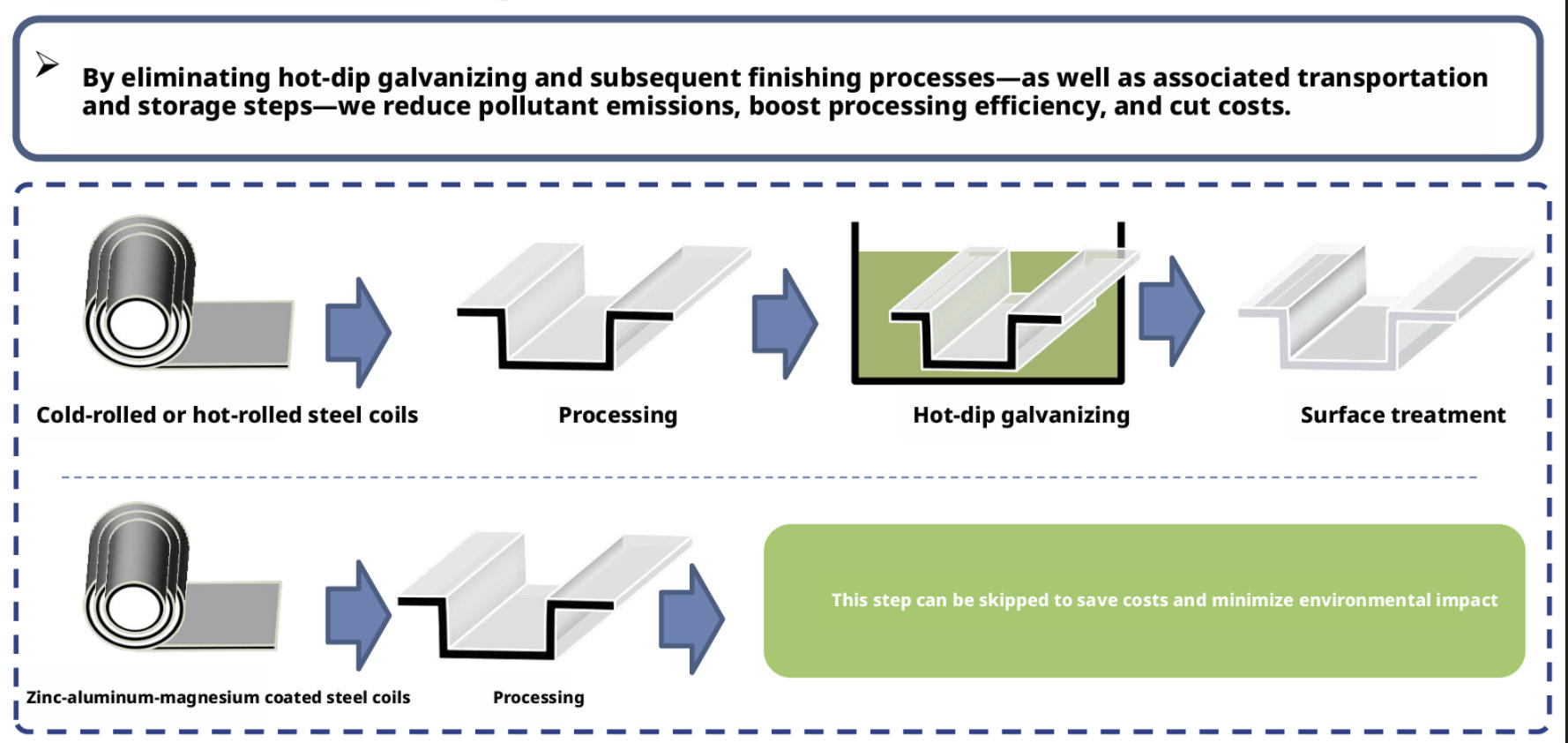
Standard HDG systems for cold-climate and de-icing exposure typically require 600-900 g/m² coating weight on both sides to achieve acceptable service life. ZAM achieves equivalent or better corrosion resistance — including in chloride-containing salt spray environments — at 90-180 g/m² coating weights. The per-kilogram cost of ZAM coating compound is higher than HDG zinc, but the dramatically lower required coating weight often brings the total coating material cost per square meter to comparable or lower levels.
Combined: upfront cost is frequently competitive
When you add reduced steel tonnage (from high-strength substrate) and reduced coating weight (from ZAM efficiency), the total installed material cost for a high-tensile/ZAM guardrail or solar mounting system often comes out comparable to — and in some cases better than — conventional HDG systems, before lifecycle maintenance savings are factored in.
Belt and Road Procurement: What Chinese Exporters Need to Know
BRI-linked projects in Central Asia — particularly those funded through Chinese policy banks (CDB, EXIM Bank) — typically require:
The Belt and Road framework that connects Central Asian corridor projects also applies to AfDB-aligned infrastructure in Africa and Vision 2030 projects in the Gulf states — Chinese suppliers experienced in BRI documentation (CITAC certifications, CCIC pre-shipment inspection, mill certificates aligned with named standards) are well-positioned to serve this broader BRI-adjacent project portfolio from a single compliance framework.
- Chinese export quality certifications: CITAC (China Inspection and Testing Certification) for material verification
- Mill certificates: Named mill and steel grade with test reports, not just "meets specification" language
- Inspection documentation: SGS or CCIC pre-shipment inspection certificates for financed projects
- Technical specifications aligned with local standards: Kazakhstani CT-K standards, Eurasian Economic Union technical regulations, or national standards as specified
Suppliers experienced in BRI export manage this documentation as standard practice. For road safety barriers and solar mounting structures shipped to Kazakhstan, Uzbekistan, and Kyrgyz projects, having the documentation package ready upfront — mill certs, coating test reports, inspection certificates — removes friction from the customs and inspection process.
Logistics to Central Asia
Central Asia is landlocked, which creates a specific logistics advantage for Chinese suppliers: rail. The China-Kazakhstan rail corridor via Alashankou (Dushanzi) provides efficient land transport for steel products from Chinese manufacturing bases to Kazakhstan, and onward to Uzbekistan, Kyrgyzstan, and Tajikistan via the regional rail network.
- Rail via Alashankou: Primary route from Chinese manufacturing (Qingdao, Tianjin) to Kazakhstan, transit time 10-15 days
- Rail to Uzbekistan: Via Alashankou crossing into Kazakhstan, then onward rail to Tashkent and Samarkand, total transit 18-25 days
- Road corridor via Kyrgyzstan: Irkeshtam and Torugart passes connect China directly to Kyrgyz and Uzbek destinations — flexible for smaller orders
- Maritime to Caspian: For Turkmenistan and western Kazakhstan, rail to Aktau or Alat (Azerbaijan) port on the Caspian Sea, then ferry or rail across the Caspian — less common but available for large shipments
Specification Requirements for Central Asian Projects
| Requirement | Why It Matters |
|---|---|
| Steel mill certificate naming the mill and grade | BRI-financed projects require named mill documentation; prevents substitution |
| Coating type, weight (g/m² both sides), test standard | Makes coating comparison concrete and verifiable |
| Third-party salt spray test (ISO 9227) with chloride exposure | De-icing salt exposure in Kazakh winter requires chloride-specific test data |
| CITAC or equivalent quality inspection documentation | Standard for BRI-financed project clearance |
| Cold temperature structural certification | Northern Kazakhstan and Kyrgyz mountain routes require documented performance at -40 degrees Celsius |
| Pre-shipment SGS or CCIC inspection certificate | Required by most BRI-funded project contracts at point of export |