Africa's Infrastructure Push Is Real — And So Are Its Corrosion Challenges
The African Development Bank's High 5 priorities — Light Up and Power Africa, Feed Africa, Integrate Africa, Industrialize Africa, and Improve the Quality of Life for the People of Africa — are channeling billions into road infrastructure across the continent. The Trans-African Highway network, national trunk road programs in Nigeria, Kenya, Ethiopia, and Tanzania, and port-to-inland corridor upgrades in South Africa and Mozambique are all creating sustained demand for road safety systems.
But Africa's environments are not kind to steel infrastructure. From the humid Atlantic coast of Nigeria and Ghana to the salt-spray exposure of the Kenyan and Tanzanian Indian Ocean coastline, from the high-rainfall equatorial zones of the Congo basin to the hot-dry conditions of the Sahel — corrosion is the enemy, and it doesn't follow procurement cycles.
Most guardrail specifications across Africa still default to hot-dip galvanizing. That decision made sense when better coatings were genuinely expensive. The material math in 2026 tells a different story — and it's worth revisiting the economics before writing the next round of specifications.
The Cost Story Has Two Parts — and Both Point the Same Direction
Part 1: High-tensile steel reduces total steel tonnage
Switching from commodity Q235 or Q345 steel to high-yield-strength grades (550 MPa+) allows guardrail structural sections to be thinner while maintaining or improving impact performance. For long corridor projects — the kind that dominate African highway procurement — this translates directly to less steel mass per kilometer. The per-ton premium on high-tensile grades is real, but the reduced quantity means the total steel cost per project is frequently neutral to favorable.
Part 2: ZAM coating requires less material, not just better protection
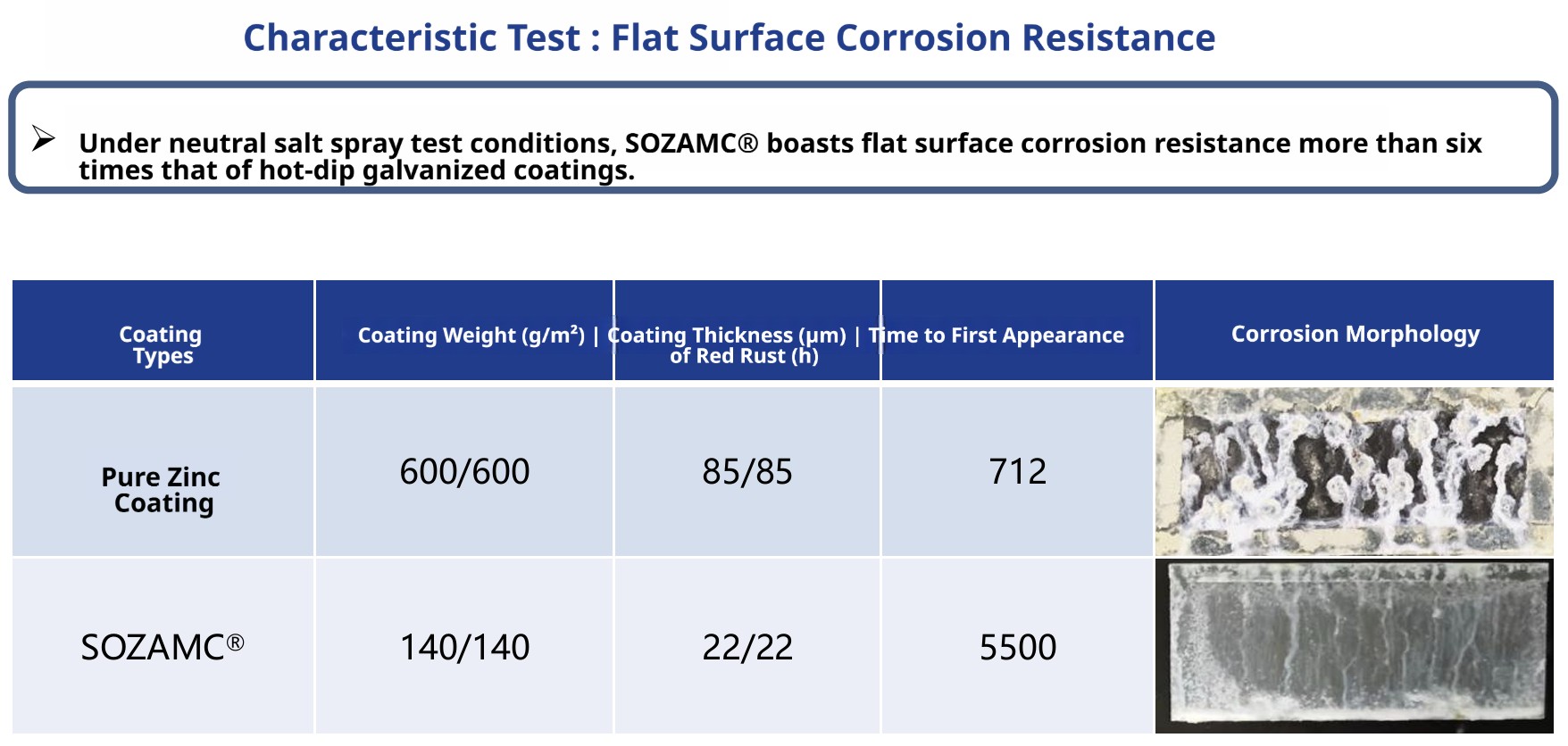
Zinc-aluminum-magnesium (ZAM) coating achieves superior corrosion resistance with significantly lower coating weights than hot-dip galvanizing. Standard HDG systems for African coastal and high-humidity environments require coating weights around 600-900 g/m² on both sides. ZAM reaches equivalent or better performance in neutral salt spray testing (1,500-3,000+ hours to red rust) at 90-180 g/m² coating weights.
The per-kilogram cost of ZAM coating compound is higher than commodity HDG. But because the coating itself is thinner and lighter, the total coating material cost per square meter often comes in lower than HDG — not higher. This is the counterintuitive part that changes the upfront cost comparison.
Africa-Specific Corrosion Environments to Account For
When specifying guardrail materials for African projects, it's worth being precise about the corrosion zone — because "Africa" isn't one environment.
Zone 1: West African coastal (Nigeria, Ghana, Ivory Coast, Cameroon)
High humidity year-round, significant salt influence near the coast, high rainfall in the wet season. HDG systems in these conditions typically show meaningful surface degradation within 8-12 years. ZAM systems in equivalent conditions show no significant degradation through 20+ years of field exposure in comparable Southeast Asian coastal projects.
Zone 2: East African coastal (Kenya, Tanzania, Mozambique)
Indian Ocean salt spray, monsoon seasonal variation, high UV exposure. The combination of salt and heat creates aggressive conditions for unprotected steel. ZAM's self-healing edge protection — where magnesium reacts with moisture to form protective corrosion products at cut edges and scratches — is particularly valuable here, since field-cut guardrail sections are common during installation.
Zone 3: Sahel and dryland corridors (Mali, Niger, Chad, Sudan)
Hot, dry conditions with sand abrasion. HDG zinc coating weathers more slowly in dry conditions but sand and dust abrasion during construction and maintenance operations can damage the coating. ZAM's harder aluminum-containing surface provides better abrasion resistance and the coating recovers at edges even when abraded.
Zone 4: High-altitude and equatorial highlands (Ethiopia, Rwanda, Kenya highlands, Zambia)
High altitude increases UV intensity and thermal cycling. Coastal-influenced highland areas experience both humidity variation and thermal cycling that accelerate HDG coating degradation. ZAM's aluminum content provides better thermal stability and UV resistance in these conditions.
Financing Structure Considerations: AfDB, World Bank, and Government Procurement
Many African highway projects are financed through multilateral development bank loans, which carry their own procurement and anti-corruption requirements. Common frameworks include:
- AfDB SBD (Standard Bidding Document) — requires international competitive bidding for above-threshold contracts, technical evaluation criteria that can accommodate performance-based material specifications
- World Bank guidelines — similar competitive bidding framework with emphasis on value-for-money evaluation that supports lifecycle cost approaches
- Government direct procurement — more flexible on specification but often more susceptible to lowest-first-cost bias
For projects under AfDB or World Bank financing, the lifecycle cost argument for ZAM systems is usually welcomed — these institutions are increasingly focused on value-for-money over lowest cost, and the data supports the economic case clearly. For government procurement, you may need to make the upfront cost case more explicitly, including the tonnage reduction from high-tensile steel and the coating weight comparison.
The same shift from first-cost to lifecycle-cost procurement is underway in Latin American highway procurement — Brazilian DNIT, Peru's Provias Nacional, and Chile's MOP are all increasingly receptive to performance-based specifications that evaluate total project cost over 20-25 year concession terms, the same evaluation framework that AfDB applies to African infrastructure.
Logistics: Getting Guardrail Systems to African Projects
Major African ports receiving steel cargo from Asia include:
- Lagos (Apapa, Tincan), Onne (Nigeria) — West Africa hub, serving Nigeria corridor projects and Sahel-bound overland freight
- Durban, Ngqura, Maputo (South Africa/Mozambique) — Southern Africa corridor, excellent port infrastructure
- Mombasa (Kenya) — East Africa hub, serving Northern Corridor to Uganda, South Sudan, Ethiopia
- Dar es Salaam (Tanzania) — Central East Africa, Central Corridor to DRC, Zambia
- Djibouti (Djibouti) — Red Sea gateway for Ethiopian highland corridor and Djibouti-Addis corridor
- Accra, Tema (Ghana) — West Africa coastal corridor
Shipping time from Chinese ports to major African destinations runs 25-35 days. Breakbulk and containerized shipment both work for guardrail orders; for large corridor projects over 500 tons, breakbulk is typically more economical. Confirm that suppliers use marine-grade packaging with VCI (Vapor Corrosion Inhibitor) liners for ocean transit — this is a meaningful protection layer during the 3-4 week voyage.
The Middle East and Southeast Asia face comparable coastal salt-spray corrosion challenges — the material logic that favors ZAM systems on Gulf coastal and equatorial coastal corridors applies equally to West and East African coastal projects. Chinese suppliers experienced in multi-region export often serve these correlated corrosion environments from a common mill batch.
What Your Procurement Specification Should Require
| Requirement | Why It Matters |
|---|---|
| Mill certificate naming the steel mill and grade | Prevents substitution of commodity steel under "meets spec" language |
| Coating type, weight (g/m² both sides), and test standard | Makes comparison concrete — not "good coating" but specific numbers |
| Third-party salt spray test report (neutral salt spray, ISO 9227) | Independent verification of corrosion performance claims |
| Production capacity documentation vs. project tonnage and timeline | Avoids supplier bottlenecks on large corridor orders |
| Export reference projects in comparable climate zones | Confirms the supplier has field experience in similar conditions |