
Why the Middle East Environment Breaks Conventional Specifications
Saudi Arabia's NEOM and Red Sea Development projects, the UAE's road expansion programs, Qatar's post-FIFA infrastructure maintenance, Egypt's Suez Canal corridor upgrades, and Oman and Kuwait's national highway networks are all creating sustained demand for road safety systems and solar mounting structures.
What makes Middle Eastern environments genuinely challenging for steel infrastructure isn't just one factor — it's a combination that creates accelerating wear on conventional materials:
- Extreme heat: Surface temperatures regularly exceed 60 degrees Celsius in summer, causing thermal cycling that expands and contracts steel and accelerates coating breakdown
- Sand and dust abrasion: Fine particulate matter during sandstorms and normal wind conditions abrades coating surfaces — HDG zinc is relatively soft and wears faster under this exposure
- UV radiation: Intense year-round UV degrades organic coatings and accelerates thermal stress on metallic surfaces
- Coastal salt: Gulf coastal projects (UAE, Saudi Eastern Province, Bahrain, Qatar) face combined salt-spray and heat exposure — the most aggressive corrosion condition for steel
- Thermal shock: Rapid temperature drops during winter nights in Saudi Arabia, Jordan, and Egypt create thermal stress cycles that HDG coating doesn't handle well over time — the same thermal stress dynamic also challenges guardrail systems in Central Asian infrastructure, where Kazakhstan's 80-degree annual temperature range combines with chloride de-icing salt exposure during winter maintenance cycles.
Hot-dip galvanizing was developed as a general-purpose industrial coating. It performs adequately in temperate climates. In the Middle East's combined heat-sand-salt environment, its limitations show up faster than its standard lifecycle projections suggest.
The Two-Pathway Cost Advantage: Not Just Better Protection, Better Value
High-tensile steel: less mass, same or better performance
Switching from commodity Q235/Q345 steel to high-yield-strength grades (550 MPa+) allows guardrail profiles and solar mounting structures to use thinner sections while maintaining or improving structural and impact performance. For large-scale highway and solar projects, this reduces total steel tonnage — and with it, total project steel cost, before you even get to the coating conversation.
ZAM coating: thinner, harder, better edge protection
ZAM coating contains aluminum (approximately 6-11%) and magnesium (approximately 2-3%) in a zinc matrix. This composition produces two performance advantages critical to Middle Eastern conditions:
- Harder surface: The aluminum oxide layer in ZAM provides significantly better abrasion resistance than pure zinc HDG coating. Sand and dust abrasion during construction, sandstorm events, and normal wind-blown particulate exposure wears ZAM coating far more slowly than HDG.
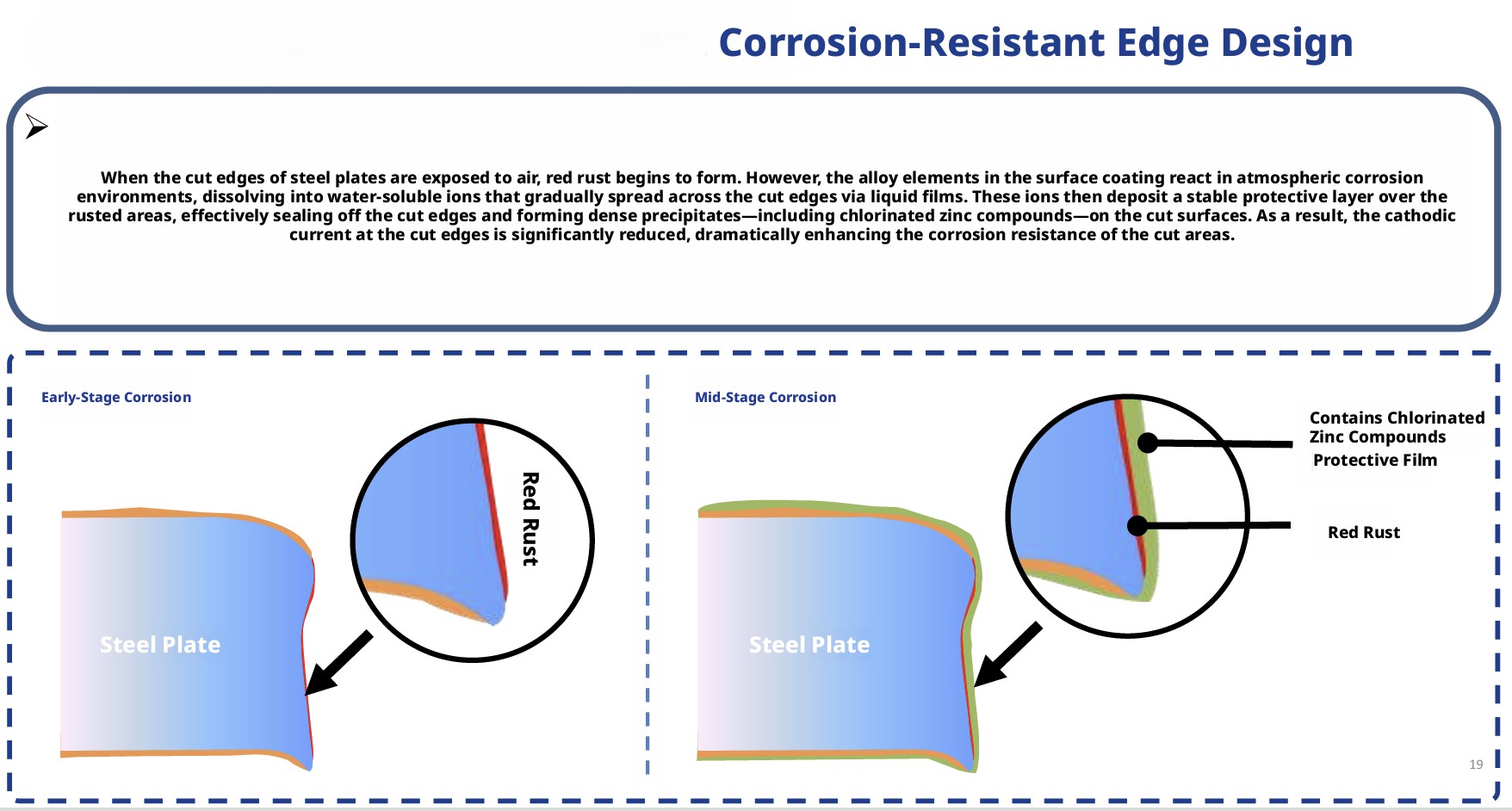
- Self-healing edges: When ZAM-coated steel is cut in the field — guardrail sections are routinely cut to length during installation — the magnesium in the coating reacts with moisture to form protective corrosion products at the exposed steel edge. HDG zinc provides no such self-healing mechanism; the edge begins degrading from day one. The same self-healing mechanism also benefits Southeast Asian coastal solar installations where salt exposure and humidity create continuous corrosion pressure at every field-cut joint and bolt hole.
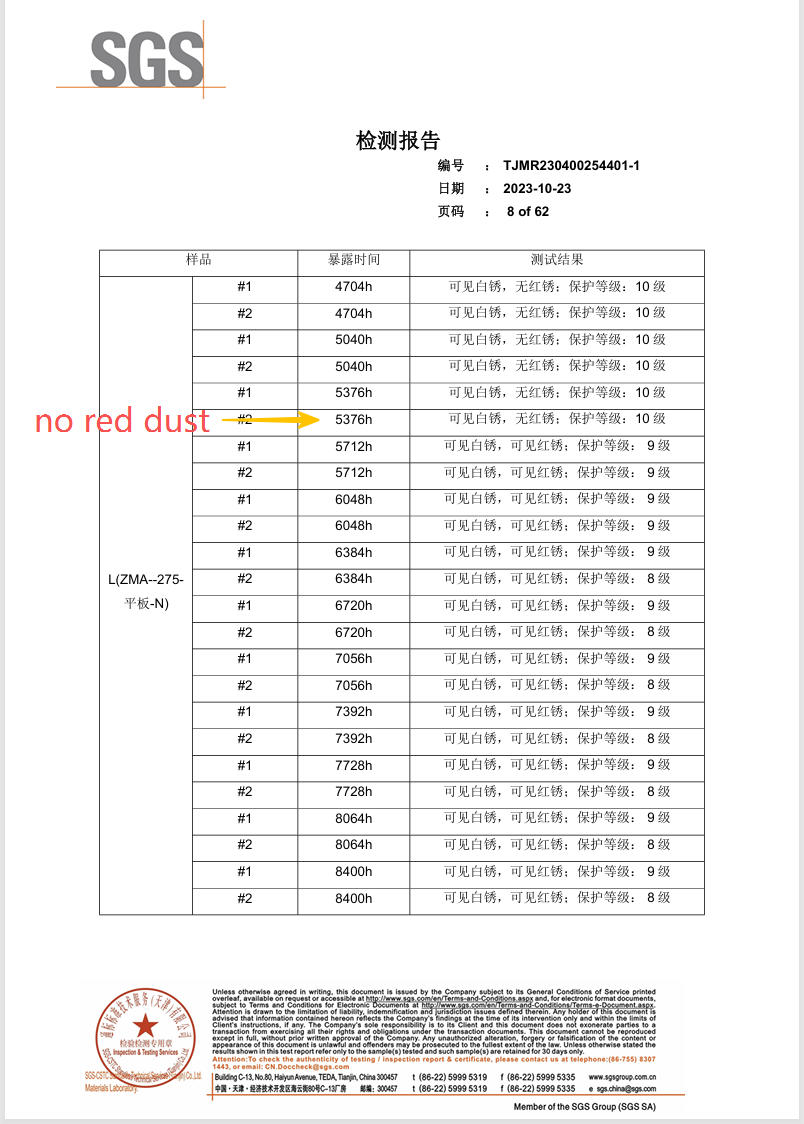
- Salt spray performance: ZAM achieves 1,500-3,000+ hours to red rust in neutral salt spray testing at coating weights of 90-180 g/m² both sides. For Gulf coastal projects, this matters enormously.
Combined: the upfront cost comparison often favors ZAM
Because high-tensile steel reduces total tonnage and ZAM coating requires less material per square meter, the total installed material cost for a high-tensile/ZAM system frequently lands comparable to or better than conventional HDG — before lifecycle maintenance costs are factored in.
Middle Eastern Application Zones
Gulf coastal corridor (UAE, Saudi Eastern Province, Qatar, Bahrain)
Combined salt-spray and extreme heat exposure. HDG systems in these zones show accelerated coating degradation from salt crystallization in the zinc coating pores combined with thermal cycling. ZAM's self-healing edge behavior and superior salt-spray resistance make them the natural choice for this environment. Solar mounting systems on coastal solar farms in this zone particularly benefit — they face salt-spray exposure year-round without the seasonal reprieve that inland projects get.
Inland desert (Saudi Arabia central, UAE inland, Oman, Kuwait)
Extreme heat and sand abrasion dominate inland environments. Surface temperatures and UV exposure create aggressive conditions for any coating, but sand abrasion is the primary degradation mechanism. ZAM's harder aluminum-containing surface provides measurably better abrasion resistance than HDG. For guardrails on desert highway corridors — Saudi Arabia's network expansion, Oman's mountain-desert transition routes — ZAM guards against the sand-scouring wear that HDG systems in these zones experience.
Mediterranean and Red Sea coast (Egypt, Jordan)
Egypt's coastal highway along the Mediterranean and Red Sea, plus Jordan's port access corridors, face combined humidity and salt exposure with seasonal variation. HDG systems show first meaningful surface degradation within 10-15 years; ZAM systems in equivalent conditions have operated maintenance-free through 20+ years. Egypt's ambitious road infrastructure expansion — particularly the Suez Canal corridor — represents a significant addressable market for better-specified guardrail systems.
Vision 2030 and Gulf Procurement: Performance Specs, Not Just Price
The Gulf states — particularly Saudi Arabia, the UAE, and Qatar — have mature procurement frameworks that increasingly prioritize performance over first cost. Saudi Aramco's steel coating standards, Saudi Ministry of Transport specifications, and UAE MOIAT (now merged into MOHAP) standards are all increasingly receptive to value-based specifications that evaluate total cost over project life.
For international suppliers, this is an opportunity: projects under GCC sovereign wealth fund mandates and Vision 2030-aligned infrastructure programs generally welcome proposals that demonstrate lifecycle cost advantages with data — salt spray test results, reference projects in comparable climates, and lifecycle cost modeling.
Logistics to the Middle East
Key ports for Chinese steel delivery to Middle Eastern projects:
- Jebel Ali, Abu Dhabi (Khalifa Port) (UAE) — UAE projects and overland to Oman and GCC
- Dammam, Jeddah (Saudi Arabia) — Eastern Province and Red Sea coast access
- Doha (Hamad Port) (Qatar) — Qatar projects
- Muscat (Sohar) (Oman) — Oman overland corridor projects
- Port Said, Alexandria, Sokhna (Egypt) — Egypt Mediterranean and Red Sea corridor access
Shipping time from Qingdao and Tianjin ports to Gulf destinations runs 18-25 days via the Indian Ocean route or the shorter Red Sea passage. For Egypt, the Suez Canal route adds minimal time to standard ocean routing from Chinese ports.
Specification Requirements for Middle Eastern Projects
| Requirement | What to Specify |
|---|---|
| Steel grade | Named mill and grade (e.g., Shougang S550HLD or equivalent), not just "meets spec" |
| Coating system | ZAM — coating weight specified in g/m² both sides |
| Third-party testing | Salt spray test (ISO 9227) and abrasion resistance data from accredited lab |
| Temperature performance | Structural certification confirming performance at operating temperatures up to 80 degrees Celsius |
| Supply chain documentation | Production capacity, mill certificates, export documentation for GCC customs |